Bestselling Author
Gay Soldiers
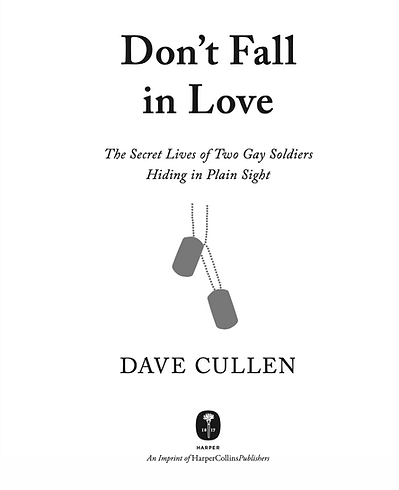
The tumultuous story of two active duty gay soldiers fighting for love and happiness against all odds. The decorated combat arms officers served in three wars and deployed to five continents, before, during and after Don't Ask Don't Tell, forging a solid friendship navigating the policy, often hiding in plain sight.
The "compromise" was designed to loosen their shackles, but Don't Fall in Love draws back the curtain on how it made life so much worse--forcing brutal compromises and pitting their life's calling against happiness with the men they loved.
Born on the eve of Stonewall, their lives tell the story of the liberation of our military and the entire LGBT equality movement, through their insightful eyes.
Don't Fall in Love
from HarperCollins
fall 2026

GLAAD Media Award
My infantry days
summary
Brett served the army in three wars: Iraq, Afghanistan and the Gulf War. Drake deployed to Iraq and Afghanistan, plus hotspots in Kuwait City, Cairo, Caracas, Port-au-Prince, and Dongducheon, Korea. They each have led extraordinary careers on the front lines of thirty years of U.S. military intervention. Both played significant roles at Guantanamo Bay, a decade apart. This sprawling story will take you inside remote foreign lands, grubby army towns, and senior Pentagon meetings, seen through the eyes of these two soldiers and a string of boyfriends, locked in a struggle with an invisible foe.
My two protagonists served on army active duty before, during and after Don't Ask, Don't Tell, and through the nation's full evolution on gay marriage, from zero to 50 legal states (after DOMA ended). Their perceptions of what they were up against changed drastically over two decades. I take you inside their world, as it evolved: believing they were ordinary army soldiers, and then the curve ball that hit them and slowly transformed their careers. Their lives weave in and out of experience with lesbians, enlisteds and sailors, airmen and Marines, but I do not attempt to document the policy's impact on every gay community. This is an intimate story of two fascinating army soldiers — and the men, and occasionally women, they loved.
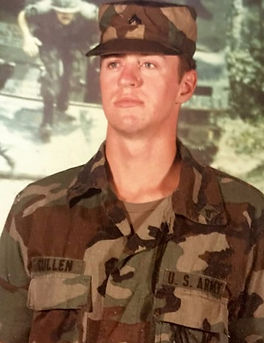
Drake and Brett bring you remarkably different perspectives. Drake is a gruff, brash good ole’ boy, with a hulking linebacker body and a wicked sense of humor, wielded in a fading Tennessee twang. Brett is a short, muscular Korean with a massive barrel chest and bubbly disposition, fond of chatting up truck drivers and clerical staff alike, and amusing them with bad puns. Brett immigrated as an infant, and as he grew up he helped raise his younger siblings, while his parents ran a deli in Queens and import shop in the Bronx. West Point turned his head around, taught him how much he had to overcome as an Asian soldier, unaware he had much bigger hurdles ahead. Battle can affect a soldier many different ways, but in Drake's case, decades of internal struggle in and out of a slew of war zones mellowed his disposition and taught him new concepts of what it means to lead.
Be Notified
Email 'NOTIFY' in the subject line: dave@davecullen.com
You'll get emails when Don't Fall In Love is available for pre-sale and when it's published.
I never share addresses, and won't spam you.
FYI: 'The Ultimate Brokeback Forum' that I created a few months before the film debuted is here. It's the primary fan forum and still growing strong, no longer at davecullen.com

Me at West Point with the gay-straight alliance Spectrum in 2016. Middle with our first out gay Army secretary, Eric Fanning, and Allyson Robinson, a 1994 graduate and transgender activist. Photos by Brett and Dave.
Origin Story
I met them at the height of Don’t Ask, Don’t Tell, researching a policy piece for Salon. I had been a gay soldier before the policy, but wanted the perspective of someone serving. All the gay advocacy groups tried to find a service member to work with me, but all failed. They told me it was hopeless — no one had ever done that; it wasn’t safe.
I knew where to find them. Colorado Springs is ringed by military bases, so I drove down there on a Saturday night. I met Brett the first night, and he took me inside their world, encouraging others to speak to me, everything off the record at first. I met several gay soldiers, marines and airmen, and it took months to win some of them over, but several agreed. I was stunned that their lives — and the ways they maneuvered about the policy — was nothing like I had expected, even as a former gay soldier, and nothing like I had read about. They had no voice, no way to tell the world.
My instincts told me almost instantly that story of their lives was so much more interesting than another policy piece, and my editor, Joan Walsh, heartily agreed. So I spent five months on an 11,000-word ethnographic story than ran in two parts in June 2000. For complicated reasons I explored in the piece, the policy paradoxically encouraged gay sportsex, but made a meaningful relationship nearly impossible. What all the guys craved, and the policy denied them, was a boyfriend. So we called the piece, “Don’t Ask, Don’t Tell, Don’t Fall in Love.” I still wince typing that 17 years later. You can read parts 1 and 2 via the links in the box. It won the GLAAD Media Award for best online story of 2000.
I eventually chose three captains with extraordinary stories — two army, one marines — as the primary focus of the Salon piece. It ran with an editor’s note explaining that we had changed their names and certain identifying characteristics. I worked with the guys and SLDN to insure we had done that safely. The guys were fully on board, though they got extremely nervous as publication date approached. It created quite a stir at their posts and throughout the military — (Drake said it still came up when he was in Iraq years later) — but no one ever figured them out. They will reveal their identities in the book.
This book has two protagonists, who I met in January 2000, in a gay bar in Colorado Springs. They were army captains, in hiding, but felt safe inside. I have been following them ever since, observing one stunning twist after another in their love lives and army careers, at close range. I’ve never had an opportunity like this as a journalist, and I hope it brings a sense of intimacy to to the book. I have gotten to know them well, and they have been incredibly candid. (It took Brett’s Asian mom 15 years to open up all the way.)
Evolution to Book
I stayed close to the guys. Drake and Brett's lives took the most amazing turns, so I focused the book on their stories, which spans three decades, across five continents. We kept up by email, phone, and countless visits, including so many major life events. While I knew them, they each deployed to the Iraq and Afghanistan wars, and played significant roles at Guantanamo Bay, ten years apart.
Brett and Drake maneuvered the policy rather masterfully in the short-run, but certain choices lit the fuse on career bombs that would erupt more than a decade later. They each found boyfriends, but had polar experiences in that realm, both harrowing, in vastly different ways. It was a harrowing ride for each of them — and the Supreme Court decision to legalize gay marriage brought more changes. I finished Columbine nine years after the Salon pieces, and I knew their story cried out for more.
Researching and writing Don't Fall in Loveh as been my primary occupation since finishing Columbine, as well as shadowing them nearly all that time, too. After 26 years work, I'm wrapping up the last round of editing, and the book went to copy editing in December 2025. HarperCollins will publish it fall 2026.
Research has taken me to their various homes around the U.S., two trips to West Point, a week in Guantanamo Bay, and three trips shadowing Drake at the Pentagon. I have published several journalism pieces on the military, gays and gay soldiers and transgender in the process, featured in the box. Prior to meeting them, I had written about the military and gays in the military for Slate and Salon, and spent considerable time at the Air Force Academy. I've included pictures from these trips throughout the page.
Don't Fall in Love also covers Stonewall; pioneers of the "homophile movement" Frank Kameny, Harry Hay, the Mattachine Society, and Daughters of Bilitis; as well Stonewall, OutServe-SLDN, the Palm Center, HRC (Human Rights Campaign), GLAAD; gay pride, gay power, all things LGBT and LGBTQIA+, scholars Aaron Belkin, Nathaniel Frank and Eric Cervini; insights from James Baldwin and Richard Goldstein; key players Sam Nunn, James Dobson, Bill Clinton, Susan Collins, General Colin Powell, Admiral Mike Mullen, Admiral John Kirby, and Nancy Pelosi.
During second round of editing the entire book in 2025, I was happy to discover so much interest in stories like this in three breakout TV series: Overcompensating, Boots, and Heated Rivalry, each one shredding me harder than the one before. Heated Rivalry just undid me. I bought the entire Game Changers series, and was thrilled to learn that Rachel Reid is a wildly talented writer. I couldn't wait for S2, devoured The Long Game in two days, and cried just as hard at the end.
These stories feel so much like what I went through, and Brett and Drake, too. (Though my gay soldiers hid for even longer: more than 20 years.) At its heart, Don't Fall in Love is a star-crossed gay love story — two actually, braided together: Brett and Drake always have each other's 6, through one tricky maneuver and looming disaster after another.